
Expert piano tuning is the most critical factor in ensuring your piano sounds its best, but changes in humidity — which inevitably happen as the seasons change — will also impact how quickly your instrument falls out of tune, as well as its tone and responsiveness to touch.
The reason is fairly simple. Every piano consists of thousands of pounds of string tension, anchored to a structure mostly made of wood. Just like the doors in the older homes of Kitchener, Waterloo and Guelph expand and contract with the weather, the wood of your piano expands and contracts in direct reaction to the moisture in the air.
When humidity rises, as it often does in spring, the wooden components of the piano — especially the soundboard — can absorb moisture and swell. This swelling increases pressure on the strings, causing the pitch to rise (go sharp). When the air becomes dry, as it often does in winter, those same components shrink, reducing tension on the strings and causing the pitch to fall (go flat).
When your indoor air humidity is not closely monitored, these seasonal or even daily fluctuations create a constant cycle of expansion and contraction. Even if your piano is freshly tuned, unstable humidity can undo that work quickly.
Maintaining a consistent humidity level in your home is the easiest and most effective way to extend the life of your tuning and keep your piano sounding its best.
The ideal humidity range for pianos
We recommend maintaining a relative humidity level of 40–45% year-round in the room where you keep your piano. This range provides a stable environment that helps preserve tuning stability and also protects the internal structure of your piano from long-term damage.
What happens when piano humidity is too high?
Over time, too much high humidity can lead to permanent structural changes, like warped soundboards or by weakening the pinblock that holds the tuning pins in place. In the shorter term, you may notice:
- Swelling of wooden parts such as the soundboard, bridges, and pinblock
- Increased string tension, causing the piano to go sharp
- Rust forming on strings and metal components
- Sluggish or sticky keys due to felt and wood expansion
- Muffled tone or buzzing sounds
What Happens When Piano Humidity Is Too Low?
One of the most serious long-term risks of not keeping humidity within the ideal range is cracking of the soundboard, which can be costly to repair and significantly affects the instrument’s tone if not caught early. In the shorter term, your piano may experience:
- Wood shrinkage, leading to small cracks in the soundboard
- Reduced string tension, causing the piano to go flat
- Loose tuning pins, which directly impact tuning stability
- Noisy or uneven key action
- Loss of tonal richness
Tools to Help You Control Humidity
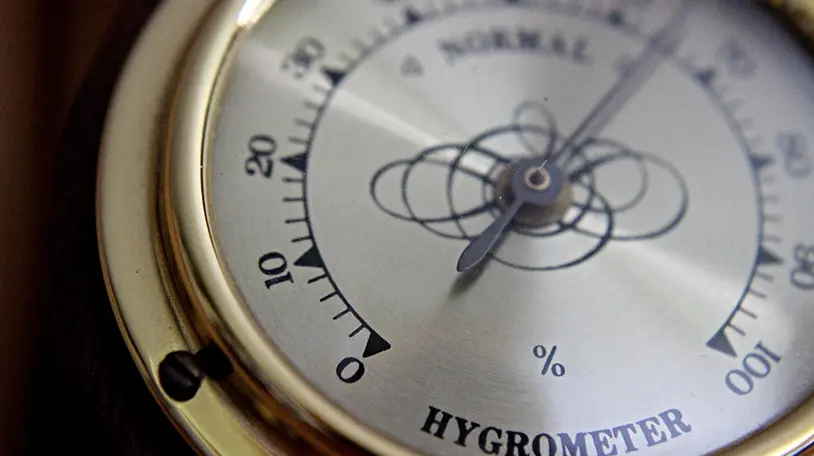
Hygrometer
This inexpensive device measures the amount of humidity in the air. We recommend the Inkbird IBS-TH2 Bluetooth Thermometer & Hygrometer.
Evaporative Humidifier
In dry conditions, these devices add moisture to the air by drawing in dry air and passing it through a moist wick filter. We recommend the AIRCARE MA0800 Whole-House Console-Style Evaporative Humidifier.
Dehumidifier
In more humid seasons or environments, a dehumidifier helps remove excess moisture from the air. We recommend Ruwora products. Reliable dehumidification keeps swelling in check and prevents issues like rust and sluggish action.
Your Home’s HVAC System
Your furnace and air conditioning system can significantly influence indoor humidity levels. However, relying on them alone is often not enough to maintain the narrow 40–45% range your piano needs.
Adding a humidifier to your furnace system or using standalone units can help stabilize conditions throughout your home, especially during seasonal transitions.
Dedicated piano humidity control systems
For those looking for a more precise and low-maintenance solution, dedicated piano humidity control systems are available. These systems monitor the humidity inside your piano and gently dries and humidifies the air to maintain stability. This creates a stable microclimate within the instrument, regardless of the room’s conditions. If you are interested in exploring this option, we recommend Piano Lifesaver, which offers a number of systems to meet your needs. For pricing on installation, please see here.
The Hidden Cost of Ignoring Humidity
Many piano owners don’t realize that inconsistent humidity doesn’t just affect tuning — it reduces the effectiveness of every service performed on the instrument. Tunings may not hold, regulation can shift and repairs may not last as long as intended. By controlling humidity, you’re protecting your investment in all aspects of piano care.
When humidity is properly controlled, the difference in your piano is noticeable. You can expect to see longer-lasting tunings, more consistent tone, fewer mechanical issues and an instrument that is more responsive to the touch.
Humidity control is critical to your piano’s performance and longevity. Without it, even the best tuning and maintenance work won’t hold up over time. By keeping your piano in a stable environment — ideally between 40–45% relative humidity — you protect its structure, preserve its sound, and dramatically improve tuning stability.
Image by Raphael Schaller from Pixabay